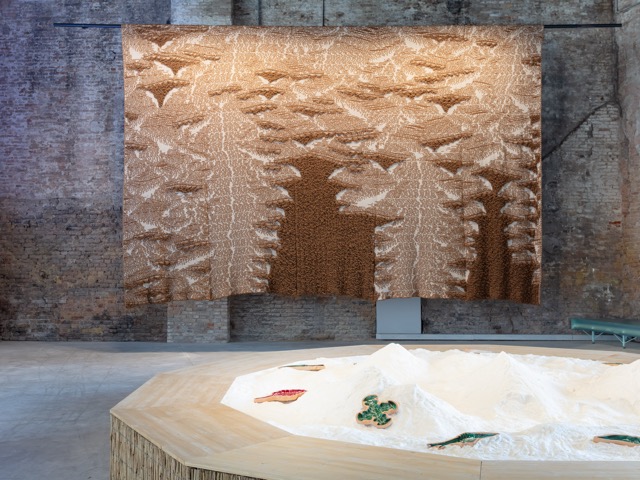
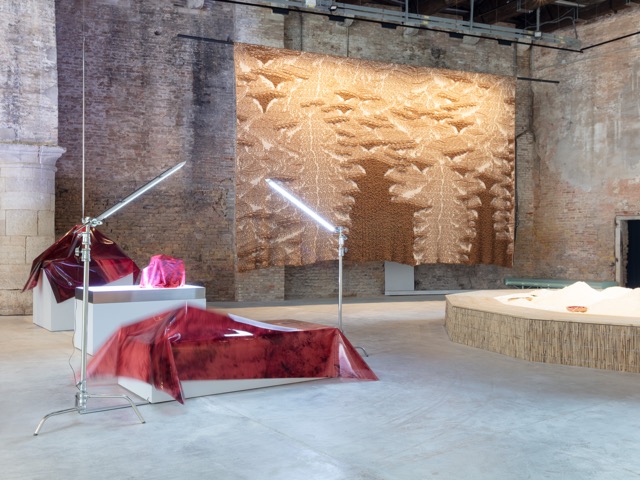
At the Arsenale of La Biennale di Venezia, The Sun Sets in a Shell came to life: the large-scale textile installation created by the artistic duo A.A. Murakami and presented as part of the Uzbekistan Pavilion, The Aural Sea.
The work, a monumental 10 x 4 metre tapestry, was created entirely using two Zegna Baruffa Lane Borgosesia yarns: nearly 100 kilograms of yarn transformed through a special automated production process that combines technical experimentation, material research and artistic language.
Part of the exhibition project dedicated to the Aral Sea and its environmental transformation, The Sun Sets in a Shell originates from the observation of the Dreissena polymorpha (commonly known as the zebra mussel), whose surfaces record over time variations in salinity, temperature and mineral composition of the water. Natural traces become memory, pattern, code.
From these geometries emerges a digital process later translated into textile through a special knitting machine called Mandarin. The result is a surface where textile structures, floating bouclé yarns and three-dimensional textures evoke marine currents, erosion and organic transformation.
Through the research of A.A. Murakami, textile transcends its technical dimension to become a visual and sensory experience: a meeting point between art, nature and technology. A vision in which yarn itself takes on a new role: not simply a production material, but an expressive element.
For Zegna Baruffa Lane Borgosesia, taking part in a project such as The Sun Sets in a Shell means seeing its textile research enter the international contemporary art dialogue, while preserving its strong connection to manufacturing culture and experimentation.
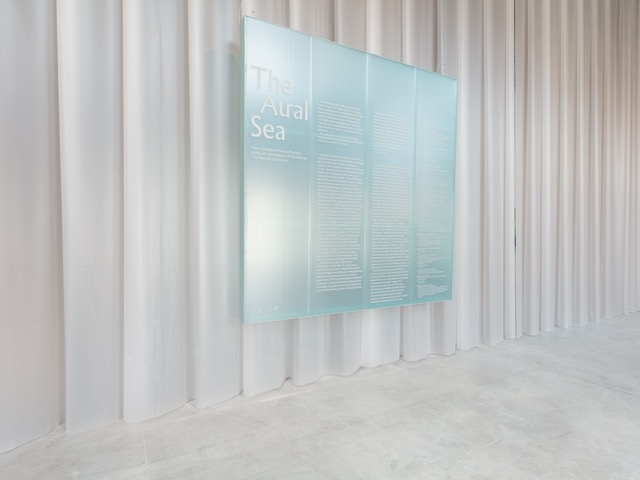
The Aural Sea will be on view at the Uzbekistan Pavilion, Quarta Tesa – Arsenale, Venice, until 22 November 2026.
Photo credits by Gerda Studio. Courtesy of the Uzbekistan Art & Culture Development Foundation.